REVIEWS
ACTRESSES
Movies free online
Showing posts with label classic movie. Show all posts
Young Frankenstein
This may just be the funniest movie of all time. Mel Brooks never before (and never again) worked with the tight parameters he did here: gene Wilder actually wrote most of the script, and that plus the use of the old Universal sets and props seem to have kept Borooks's more sophomoric instincts (which have gone overboard in some of his later films) tightly in check. Thus he--and everyone else in the film--is doing their absolutely finest work ever.
From Teri Garr "rolling in ze hay," to Kenneth Mars's inspired Police Inspector, everyone in the entire film seems to be working at their most hysterically hilarious. Special mention must be given to Gene Wilder giving one of his most classic performances of his strangled-fury schtick ever ("Put... the candle... back!!!") and to Peter Boyle, for his very poignant and funny depiction of the Monster.
But standing above all of the end in terms of sheer brilliance is Madeline Kahn, giving what must be the funniest female performace ever on film as Frankenstein's fiancee and the monster's eventual bride. Unlike everyone else in the film, she's not really parodying anyone other than herself; yet nevertheless her depiction of Elizabeth, the wealthy prude who discovers she's a volcano of passion undeneath, is so funny I'm practically crying almost every time I see this film. There's one brief little scene where she's brushing her hair in her boudoir before the Monster steals into her room and kidnaps her, and for absolutely no apparent reason(which makes the scene all the funnier) she's giving vent to a deeply lusty rendition of "The Battle Hymn of the Republic" while brushing out her hair. It is the funniest five seconds in the entire film--and in a film this hilarious that's saying a lot.
Posted by : Ela on | Labels: classic movie, old movies, Young Frankenstein |
Mary Poppins
"Mary Poppins" is one of that select group of films that can truly be called 'Classic', a project conceived in love and filled with so much child-like wonder that it will never grow old or 'out-of-date'. Certainly the crowning achievement of Walt Disney's remarkable career, the "Mary Poppins" 40th Anniversary Special Edition is simply magnificent! Based on P.L. Travers' tales of a magical nanny who arrives to bring families closer, the rights to the stories had been pursued by Disney since 1938, but Travers had seen what studios had done to other authors' works, and withheld her approval unless she could maintain some creative control. Years of negotiations only whetted Disney's desire to make a definitive, truly 'special' film, and by 1960, despite the box office failure of another fantasy-themed 'pet' project, "Darby O'Gill and the Little People", he was more confident than ever in the story's potential, bringing together a remarkable array of talent, including songwriting brothers Richard and Robert Sherman, production head Bill Walsh, and the brilliant artist Peter Ellenshaw to 'visualize' 1910 London through his matte paintings. With Travers' grudging approval, casting began. While American stage and TV star Dick Van Dyke was an odd choice to play a Cockney chimneysweep, he was a gifted mime and physical comedian, and had such a wholesome exuberance that Disney knew British audiences would forgive his shaky accent. Popular British actors Glynis Johns and David Tomlinson would play the preoccupied parents, with Karen Dotrice and Matthew Garber (from "The Three Lives of Thomasina") as the neglected children. Veteran stars Ed Wynn, Elsa Lanchester, Reginald Owen, Arthur Treacher, and Jane Darwell (as the Bird Woman, in her last screen appearance), headed the strong supporting cast. But it was the casting of Julie Andrews, in her first film, as Mary Poppins, that truly 'made' the film! Passed over by Jack Warner for the movie version of her stage hit, "My Fair Lady" (he opted for Audrey Hepburn), Disney caught her performance in "Camelot" on Broadway, knew, instantly, that she was the right 'Mary', and approached her for the role. "But I'm pregnant," she told him. "No problem," he replied. "I'll wait!" And thus a Classic was born! A multiple 1964 Oscar winner (including 'Best Actress' for Andrews, who got to share the stage with her "Lady" costar, Rex Harrison, who won 'Best Actor'), the film was a major hit, worldwide, and quickly achieved the legendary status it holds today. For it's 40th Anniversary, Disney's heirs have put together a spectacular package; along with the digitally-remastered film (it looks and sounds SUPERB!), a second disc of additional features includes a joyous reunion of stars Andrews and Van Dyke (who both seem ageless!); reminiscences of Robert Sherman, who sings a cute ditty cut from the final film; a fascinating 50-minute "behind-the-scenes" documentary about the production; featurettes on how the FX were achieved in several key scenes; and much, MUCH more! As the owner of several "Special Edition" Disney DVDs, I can honestly say, THIS is the BEST, yet!
Posted by : Ela on | Labels: classic movie, Mary Poppins |
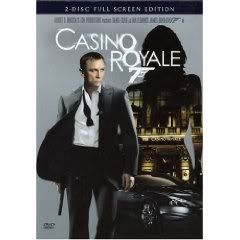
Casino Royale
When last we left him in 2002's Die Another Day, James Bond (Pierce Brosnan), armed with an invisible Aston Martin, a gun-toting Halle Berry at his side, had just defeated a face-changing Korean colonel and his giant space laser. If that description elicits more of a groan than a gasp, you're not alone. After forty-plus years of cinematic spectacle, it's easy to understand why Agent 007's recent adventures haven't done very much to leave expectant audiences shaken or stirred. It wasn't always like this, of course. There was a time when a James Bond movie represented the pinnacle of filmmaking -- both unceasingly innovative and wildly subversive at the same time. With their unparalleled technical prowess coupled with heaping helpings of violence, action, and innuendo, the early Bond films forged the path that nearly all commercial blockbusters follow to this very day. But then, that was a long time ago. By the time I watched my first Bond, 1979's Moonraker, the series was firmly ensconced in the (quite-successful, mind you) Roger Moore-era, and had long since traded in narrative trailblazing for a kind of baseline consistency and an insistent clinging to formulaic repetitiveness. And yet, there was something oddly reassuring about it. It was just one of those things. Every couple of years, you'd go to the theater, that strobe light/gun barrel opening would come up, and you'd watch 007 save the world yet again. It didn't have to be a good movie; it just had to be a Bond movie. Well, it's taken awhile -- several decades, in fact -- but with the release of Casino Royale, the 22nd film in the invincible series, we can finally, definitively say that the two are no longer mutually exclusive. James Bond is back, and as it turns out, he's been gone a lot longer than anyone even realized. As soon as the lights go down, before the opening credits even start, we know right away that something is different. What is it? That famous opening shot. The gun barrel motif that has signaled the beginning of every official Bond movie from 1962's Dr. No until now -- it's not there. And just like that, all our preconceptions of what to expect are kicked to the curb. When you think about it, the Bond producers have done something that's really unprecedented for a series as successful as this has been (each of the four Brosnan entries made more money than the last) -- they've dared to buck tradition and go in a new direction, winding the clock back for a Batman Begins-style reboot, giving us a ground-up look at James Bond's first mission. Taking its title and basic plotline from Ian Fleming's 1952 debut 007 novel, the film revolves around a high-stakes poker game that the wet-behind-the-ears Bond (Daniel Craig) is recruited to participate in against terrorist broker Le Chiffre (Mads Mikkelsen). It's a straightforward affair, with none of the standbys we've come to know and expect from these things -- no banter with Q, no fancy gadgets (nary an invisible car to be seen), no innuendo-laced banter with Miss Moneypenny, and an honest-to-gosh love story with new Bond girl Vesper Lynd (Eva Green) dropped down right smack in the middle. This is the Bond formula stripped bare, and every frame bespeaks the joy of rediscovery, with the gleeful abandon that comes with freedom from the stultifying sameness that has crippled this franchise for the past twenty-some years. As embodied by Daniel Craig, far-and-away the best actor to don the trademark tux since it was doffed by Sean Connery in 1971; the character is more meat-and-potatoes than caviar and escargot, and for the first time in seemingly ever we get a sense of the raw brutality and casual cruelty that drives him. Paradoxically, Craig also makes him far more real than he's ever been by also showing us a vulnerable side to this heretofore unshakable assassin. This is no easy task, as both Timothy Dalton and Brosnan before him tried and failed to lend some much needed gravitas to the usual 007 derring-do. At just under two-and-half hours in length, Casino Royale is longer, even, than the George Lazenby-starring On Her Majesty's Secret Service (one of the best in the series), and yet, from a breathless opening footchase in Madagascar to a cat-and-mouse game in Miami to a showdown in the canals of Venice, it remains utterly involving for its entirety. Much of the credit for this can go to star Craig, who electrifies from his first scene, as well as director Martin Campbell. Campbell, who also helmed Pierce Brosnan's 1995 007 debut, GoldenEye, also seems to have benefited greatly from the franchise's reinvention, employing a style here very clearly beholden to such recent spy outings as the Jason Bourne movies (as evidenced by a visceral bathroom brawl before the opening credits, depicting Bond's first kill). Ultimately, it's a bit of a wait before we finally hear Craig utter that most famous of lines -- "Bond. James Bond." -- the whole movie, in fact. But by the time he gets there, and by the time we first hear Monty Norman's "James Bond Theme," we realize that the usual promise at the closing credits that "James Bond Will Return," has finally transcended the constraints of the familiar and become something it hasn't been in quite awhile: something worth getting excited about.
Posted by : Ela on | Labels: Casino Royale, classic movie, movies review |
Enchanted April
Mike Newell's film casts a seductive, mesmerizing spell on its audience. I strongly encourage you to see it if you have not.
Josie Lawrence leads a strong cast as Lottie Wilkins, a dowdy London housewife who we meet in the film's first frames trudging through post-WW I London. We meet Alfred Molina as her overbearing husband, Mellersh, who eyes all relationships as potential business opportunities, and sees his wife as not much more than a pet.
Lottie is riding on the bus in the dreary rain one day when she sees an advertisement on the back of the paper for an Italian Castle to be let for the month of April among the "Wisteria and Sunshine". Lottie's life hasn't allowed her much love or friendship, but she decides that she MUST take this April Holiday at San Salvatori. She approaches Rose Arbuthnot, who she barely knows, but has seen looking sad at Church services.
Rose is played by Miranda Richardson in a performance that suggests, if anything, that she has had her happiness even more suppressed than Lottie. Her husband, Arthur, is played by Jim Broadbent in full ruddy-faced glory. Arthur is a hedonistic author who writes pulpy trash novels with names like "Theodocia, the Slave Princess". He also chases after other young women who come closer to meeting his ideal of fun than his pious wife.
Lottie and Rose secure the rent of the villa and decide to advertise for a couple of other ladies to share the expense. Joan Plowright plays Mrs. Fisher, an older lady who grew up bouncing on the knee of the great English Poets of the day. Blundering Lottie asks "Oh, did you know Keats?" a century and a half after Keat's day.
"No", Mrs. Fisher replies with disdain. "And I didn't know Shakespeare or Chaucer either."
Polly Walker is the poster-girl of the group as Lady Caroline Dester, daughter of an extremely rich and aristocratic English Lord. Caroline moves in the most social of circles, but she has grown tired of being around men who paw and grab after her. She just wants a little time to "smooth her feathers".
Michael Kitchen plays George Briggs, the owner of the Italian Castle. Mr. Briggs is something of a mystery, as it appears that he is a wealthy English businessman, but he is also a gifted musician in addition to owning an Italian Castle, complete with a full staff. He is extremely short-sighted and doesn't bother to keep his immediate surroundings tidy. His few scenes are among the best of the movie.
These 4 ladies converge upon the Italian Castle and there... magic happens. I could go into detail, but I'd spoil you the pleasure of finding out for yourself. There are several times when the plot throws a wrench into the works, and in a different, lesser story, the movie would have degenerated into hysterical "drama". The way this film reveals and resolves these confrontations is like.... a breath of fresh Italian breeze through the Wisteria. I would ask only that you consider the shots of the moon in the penultimate scene - consider what the size and location of the moon means with regard to the tone of what is happening in the scene in the foreground. It is delightful.
If you can watch "Enchanted April" and not be charmed I feel truly sorry for you. It is on my very short list of very favorite films.
Posted by : Ela on | Labels: best movies, classic movie, Enchanted April |
My Fair Lady
MFL is a marvellous film about a professor who turns a common flower girl into a lady. It is full of sing-a-long songs and funny moments. It is basically a classic for all the right reasons! Plenty of re-watch factor makes it a film to own. In 1994, the film was restored and thank the lord they did! The film's negative was almost lost forever. In fact, the film had become yellow-tinged and full of scratches, blotches and all the rest! It would have been a very sad day for the movie industry if a flim like this had been lost. The original DVD that featured this new restoration was released in the late 90's. This DVD included a 9 minute featurette, actor profiles, audio commentary, and Audrey Hepburn singing in 2 scenes. This original 1-disc DVD has since been updated to a special 2-Disc Edition. Which one to get? I have both so I feel qualified to answer this. The new DVD includes all the features found on the original DVD, except the actor profiles. The new DVD once again includes the restored print but is apparently a new transfer from the restored print. However, according to a report that I have read, the new transfer is not perfect and has aliasing problems throughout. The average watcher probably won't pick up on this detail. If this is an issue to you, purchase the original edition DVD where the transfer has been given two thumbs up! The advantage of the special 2-Disc Edition DVD is that it includes a 58 minute 1994 documentary hosted by Jeremy Brett (Audrey's love interest in the film). Jeremy is no longer with us, so it's nice to have this as a piece of nostalgia. On top of this, there are many more features on this disc that aren't included on the original DVD such as footage from the film's premiere, production dinner, as well as discussions with Rex and Audrey.
This is a extremely elegant and stylish movie - the kind of spectacle that you just don't see any more, in a certain type of Technicolour that just isn't duplicated these days. Extremely witty and classic songs, a swish script, and gorgeous costumes. Admittedly, it is eye candy, but what eye candy! George Cukor directs it with true aplomb, turning "Titanic-era" London into a stylised and colourful melée, bringing out the humour and joyfulness of the screenplay, and Cecil Beaton's extravagant and yet, somehow, chic costumes and sets form a perfect setting for the actors - and the actors themselves are superb. Rex Harrison is totally believable as Henry Higgins, mixing crustiness with a very dry humour, whereas Audrey Hepburn looks just right as Eliza Doolittle. One is forced to ponder what Julie Andrews would have done in the role, following her playing the part on stage, but I just can't see Eliza played by anyone other than Audrey Hepburn, who is, quite simply, delicious. From the mawkish, ramshackle flower-girl, to the rebellious pupil, to the cool and composed "lady" of the title, she is perfectly credible, whether throwing a Cockney temperament, or floating through the conservatory, calmly sending Professor Higgins about his business. I am told her Cockney accent is awful, but being deaf, I cannot comment; no more than I can comment upon the fact that apparently her recording of "Oh Wouldn't It Be Luverly" has been reinstated upon the soundtrack. The appeal for this film lies in its spectacle - I saw it at the cinema once, in an arthouse revival, and it was utterly amazing - and in the speech therapy storyline, which has a lot of relevance to me. "My Fair Lady" is simply... a cinematic glory of a particular type that would be impossible to duplicate ever again. The Ascot scene is worth the money alone, a refreshing, gliding harmony of black and white, choreographed and stylised escapism, totally summing up the essence of a musical.
Posted by : Ela on | Labels: audrey Hepburn, best movies, classic movie, george Cukor, my fair lady |
Subscribe to:
Posts (Atom)