WWE star John Cena headlines his sophomore action picture as a police officer whose wife is kidnapped in New Orleans. Daniel Kunka provides the script, with Deep Blue Sea's Renny Harlin handling the directing duties for the 20-million-dollar Fox Atomic/WWE Films production.
Showing posts with label bestseller. Show all posts
Showing posts with label bestseller. Show all posts
Dance Flick

Director: Damien Wayans
Stars: Marlon Wayans, Shawn Wayans (Full Cast)
Studio: Paramount Pictures
The Plot: Street dancer Thomas Uncles (Damon Wayans, Jr.) is from the wrong side of the tracks, but his bond with the beautiful Megan White (Shoshana Bush) might help the duo realize their dreams as the enter in the mother of all dance battles.
Little is known about the new Wayans Bros. comedy, but if that plot outline holds true, the brothers could be retreating back to White Chicks territory in order to put the uninspired Little Man behind them. (Remember when the "baby" hit his adoptive father with a frying pan?) I'm probably in the minority here, but I truly wish Keenen Ivory Wayans would get in more of a 90s mindset, when he wrote scripts like I'm Gonna Git You Sucka and Hollywood Shuffle. If that can't happen, strive to create scenarios that as are funny as the best bits from the first two Scary Movies.
Valkyrie

All Historical Dramas faithful to the actual events run the risk of being dry and boring. Fortunately, although it is a bit dry here and there, the producers of Valkyrie didn't stray too far in that direction. The story is well-told, and I did not feel that it dragged or got into excessive and boring detail at any point. If you are a student of WWII, and particularly this famous failed attempt to assassinate Hitler, you will be pleased with the quality of the film, the acting, and the film's faithfulness to facts and to the tone of the times. The film brings forth many details of which I was not aware, and the historical facts I know-of from past research are accurately portrayed.
It is clear computer graphics are used extensively in this film, since many of the scenes could not have been filmed in any other way, more than 60 years after events took place. The special effects are for the most part well done, and are not intrusive - clearly used only as needed to support the story instead of being an excuse to show-off a studio's CGI capabilities.
As for acting, this story was an excellent vehicle for Tom Cruise. I feel Cruise's portrayal of Colonel von Stauffenburg, who was a central figure in the assassination plot and this story, was excellent and believable. Some may argue that the characterization is a bit wooden, but I suspect this may be intentional on Cruise's part, and in keeping with the historical figure: a decorated soldier filled with anger towards Hitler, who could survive in the upper levels of the German Army only by masking his true feelings.
The rest of the cast is phenomenal. I was amazed at the number of familiar and respected actors and actresses that appeared in relatively minor roles throughout the film. Not a single performance was less than I would expect from such a cast.
The film is not a light-hearted one, nor does it end well for most of the characters. There are several bloody scenes, but none of the violence is gratuitous. As such, this is a film that will be appreciated primarily by those interested in the history of WWII, or are solid Tom Cruise fans. I am well pleased with the film as a whole, and feel the end product meets the goals of both the producers and their intended audience.
The Reader

`The Reader' is a masterpiece. Okay, I'm done now. Having read Bernhard Schlink's beautiful novel I was really anticipating this film. I feel that Kate Winslet is the finest working actress today and this just seemed like such an ideal role for her (Oscar, if you pass her over this year I vow to never watch another telecast). I of course try and shrug off all `high expectations', and thankfully with `The Reader' there was no hype. It hasn't been hailed as the best of anything, and while it has landed on a few top ten lists it rarely breaks close to the top. The reviews have been mixed, some raving it as a masterpiece, some labeling it a faux; an imitation of a more insightful film. The only awards the film has garnered up until the point have been for Winslet so walking into the film, I was not feeding into hype. I was simply hoping to see a good movie. The film tells the story of Michael Berg, a young fifteen year old boy living in Post-WWII Germany. One day while making his way home he falls ill and is helped back by an older woman named Hanna. After waiting out his illness he attempts to thank Hanna but he winds up falling into a steamy affair. The two bond over books, using reading as a form of foreplay, and the two become almost inseparable. Then for no apparent reason Hanna leaves town without a word and Michael is left wondering why his only love has left him. Years later while Michael is attending law school he gets the opportunity to sit in on a trial being held over war crimes and is stunned, and ultimately heartbroken, to see Hanna is one of the accused. First and foremost it should be addressed that this is not your typical Holocaust film, for quite frankly the Holocaust is the least impressionable part of this film. The film, like the novel, deals strongly with the feelings of guilt and redemption. There is a moral play that runs throughout each scene that begs the audience to cast judgment, but not in an absolute way but in a more complex and understanding way. `The Reader' has no easy answers, but it throws at the audience a bit of a conundrum. It reminds me very much of `Dead Man Walking', a film that appears to have such an easy answer yet causes you to rip apart your own ideals. I am keeping SPOILERS to a minimum here, but be forewarned that there may be a few. When we meet Michael and Hanna they seem like an odd match. He is obviously better off financially than she is. He is attending school and is doing rather well. Hanna is working a dead end job and living in a small apartment. Her education is limited but her yearning for more is apparent. There is an attraction physically, which cannot be denied. While Hanna is rough due to the nature of her life she is a diamond in the rough, a beautiful woman trapped within the shell of her former life. Michael is young and coming into his own; a handsome boy with a head on his shoulders. There's innocence within him that Hanna desires. Their relationship is very fast and very graphic, but there is a sincerity there that one needs to truly look for. Some have complained that the relationship was pure surface; nothing but lust. They are missing something crucial. `The Reader' is a film filled with quiet moments that speak volumes about the characters. There is a deeper connection between these two souls, one that maybe they can't even recognize. There is a moment where Hanna finds herself inside a small church listening to a young choir and the tears are streaming down her face, and as Michael watches her from the doorway we can see it; even if he or even she doesn't truly understand it. It is there. As the film progresses and the two are separated we begin to truly see the deeper connection that they are feeling for the first time. As the trial proceeds Michael is caught between his own feelings of right and wrong; between what is ethical and what is not. He is disturbed by the revelations concerning his former love; distraught over what this means for him and whether or not it had anything to do with his personal attachment to this woman. Can he bring himself to hate her? Can he bring himself to forgive her? Does she deserve that hatred or that forgiveness? There is a moment when Michael is attempting to visit Hanna in prison when everything makes sense; his eyes swelling with an emotion he has yet to fully realize. He struggles to convince himself that he hates this woman, because hating her would make it easier to forget her. `The Reader' is a masterfully crafted tale of love and loss; of what we tell ourselves in order to better understand something we haven't the capacity to grasp. There is the shame in Hanna's eyes as she hides her secret (one that you no doubt had guessed long before it was revealed, but the revealing of the secret is not really the point of the story), willing to sacrifice her very life so as not to be downgraded or looked down on. There is the guilt in Michael's eyes as he blames himself for Hanna's fate, unable to step outside his skin long enough to decide the correct course to case. This is a story about mistakes and missteps and regrets and the ultimate loss that comes from not fully understanding how to feel. Technically, this is a flawless film. I remember reviewing `...Jesse James...' last year (this site still won't let me type in that full name) and going on and on about how technically perfect it was, from the cinematography to the score to the lighting to the mood to just about everything. `The Reader' is the exact opposite in scope yet just as profound. It is a much subtler film, and so the score, the lighting, the cinematography and the set designs are smaller, yet just as pristine. Everything is so crisp and delicate; adding layers to the mood perfectly presented by director Stephen Daldry. I was a little hesitant about Daldry's ability to transfer Schlink's novel to the big screen. I loved `Billy Elliott' and continue to love it more and more every time I watch it, but Daldry's latest effort was that 2002 debacle `The Hours' and so I was truly afraid that he was going to run the same gamut and deliver a similar piece. `The Reader' is not only much more profound and poignant, but it is also executed much better than `The Hours' (to be fair, I need to watch this movie again, but I was not impressed the first or second go around). When it all boils down to it though, this movie is all about two things; Kate Winslet and David Kross. Both actors deliver career highs (and to say that about Winslet is saying a lot since she is always top notch). Their performances are truly organic. That has become my new favorite word this year, for I feel as though it truly taps into the depth of these performances. There is a naturalness that fortifies itself within these performances, deepening with each flicker in the eyes or twitch under the skin. Try your hardest to watch Winslet's face (I know it's hard, especially since she is without clothing for practically the whole first hour of the film). There is a scene where she is lying in the bathtub and Kross comes in to hash out their argument. As he speaks you can see for the first time her hard exterior melting away and revealing this woman that she doesn't even know exists. It is so subtle yet so profound. Winslet is utter perfection. Kross is just as superb, sinking into his character and delving deep into his emotional responses to his current situation. The scene in the courtroom (all of the courtroom scenes are beyond breathtaking) when he notices Hanna for the first time is utterly immobilized. Watch as Kross exhibits such a natural gut reaction; as controlled as he can be yet giving way to lapses of uncontrollability. The supporting cast is also superb, from Fiennes' dynamic understanding of Michael's emotional regression to Bruno Ganz's grasp of the real situation at hand. The one standout here is truly Olin, who proves to be one of the most important facets of the film. Her final scene with Fiennes is what makes the movie work, dispelling any easy sympathies for Hanna's atrocities with her cold standing. For anyone who has complained (and there have been many) that this film tries to condone the actions taken by Hanna I urge you to rewatch and study this scene, for in a few short words Hanna's actions are condemned wholeheartedly. Remember, it is not her actions that we are sympathizing with, it is her inner person; cold and rigged yet incomplete, pleading for something or someone to make her feel whole. Thanks in large part to David Hare's marvelous adaptation, `The Reader' lives up to its source material and delivers a truly outstanding and utterly astounding look at this tragic yet beautiful love story. If you walk away from `The Reader' unmoved then maybe you are just plain unmovable. I'll close by saying that the Oscar's have passed, Kate won the gold (YES!!!) and I still agree wholeheartedly with every word in this review.
Indiana Jones and the Kingdom of the Crystal Skull

I love the first three Indy films. Like so many others I was greatly looking forward to seeing a new one. I thought (or hoped) that the very long time they took to come up with a script meant they were polishing it to a brilliant shine. After seeing the movie, I conclude it was really a long negotiation between Lucas, Spielberg, and Ford, with some of them eager to make a crappy movie, and some of them not, with the end result being crappy, but perhaps not as crappy as it might have been. The movie started with a bit of promise (other than the infantile CGI prairie dog). I'm not as offended by the nuclear fridge scene as many are, because I know those mock towns weren't built at Ground Zero (or they would have been vaporized). They were built at a distance to judge the effect of the blast on places some miles from the explosion. So while it's not credible for Indy to survive being tossed around that much, he didn't exactly survive a nuclear explosion. Some of the other early scenes, such as those where Indy is actually discovering something, are also good. Still... About halfway through the movie, despite my fervent desire to like it, I realized it just wasn't working for me. No suspense. No real sense of urgency or danger. Low stakes. Too many marginal or pointless characters. Too much cartoon nonsense going on, far less believable than anything from the previous films (the stupid monkey vine swinging, Marian's idiotic tree-driving stunt, the multiple waterfall drops...none of it scary, none of it remotely convincing, or even fun). Marian's long-awaited big reveal was one of the biggest, flattest duds in film history. She shows up and spends most of the rest of the movie just tagging along with a dazed grin on her face like she was just grateful to be there, a flaccid dishrag compared to the character from the first film. Not Karen Allen's fault...she was just thrown in for nostalgia's sake, and was poorly written. Mutt was actually not a bad character, but I don't need or want him to be Indy's son. Is there any worse cliche in fiction than the Son He Never Knew He Had? I realize Spielberg and Lucas are fascinated by father issues, but I'm not. And then there's the whole point of the movie...the skull and the aliens...ehhhh. Who cares? The finale was a muddled jumble of flashing lights and wind that meant nothing and evoked nothing but tedium. Remember at the end of the previous films, where the characters actually seem to notice that something extraordinary has happened, were even scared, or traumatized just a little bit (okay, not so much in Crusade, where they quickly shake off any aftereffects and devolve into slapstick and lose all interest in their surroundings). Not this time. The giant flying saucer takes off, and Indy and his massive crew of sidekicks start cracking jokes. I'm inclined to blame Lucas for most of this mess. He's made a habit of lapses of taste and judgement since...hmm..."Howard the Duck"? I don't want to see this movie again, and I don't want to own it. I hope they don't make another, because these guys have proven they no longer have what it takes.
Tropic Thunder

Here's the plot: the story of a bunch of actors, lost in the jungle and beseiged by drug-runners led by a twelve-year-old boy, who are filming the story of a bunch of soldiers lost in the woods and beseiged by Viet Cong. The film stars Ben Stiller, Jack Black, Robert Downey Jr., Jay Baruchel, Brandon T. Jackson, Danny McBride, and Nick Nolte. It features supporting roles by Matthew McConaughey, Tom Cruise, Steve Coogan, Bill Hader, and cameos by others. It was written by Stiller, Justin Theroux, and Etan Cohen, and was directed by Stiller. We got that out of the way? Good. Because here's the deal: "Tropic Thunder" is funny. And smart. How often do these go together, nowadays? They used to, back when Mel Brooks was running the show, and it's popped up again here and there, with "Knocked Up," "40 Year Old Virgin," and "Forgetting Sarah Marshall." But "Tropic Thunder" has something all those movies don't: A point. The message isn't just about Hollywood, either; it's something about all of us, who pretend to be what we aren't. It's human nature to make believe; it's human nature to give into those beliefs and think they're real. Okay. Enough philosophy. I'm putting my soap box away. "Tropic Thunder" is absolutely gut-bustingly hilarious. It's also highly offensive, crude, and over-the-top; there are jokes that go to far, there are jokes that don't go far enough. Such is the nature of comedy. My point is, even the few jokes that fall flat serve to make the rest of the movie all the better. And it doesn't hurt that the film evokes the best from its three headliners: Stiller has never been funnier (I'm not a huge fan of his, but I have to say, the man approaches, in this film, something akin to comedic genius); Jack Black, likewise, is in top form (again, I'm not a big fan; but here, he's absolutely terrific); and Downey is, simply a wonder to behold. With all due respect to the rest of the cast and crew: This film would not be what it is without Downey's presence. It's not that he's portraying "a dude disguised as a dude pretending to be another dude" (in this case, a white Australian actor playing an African American); it's that he portrays it so eloquently. You never doubt his authenticity, a method actor so lost in his role that he doesn't drop character until after he does the DVD commentary. The entire cast is hilarious; Downey is also thoughtful and intriguing. "Tropic Thunder" is not for the faint of heart, or those who like their jokes clean, or those who like their movies without much thought put into them (if "Norbit" is your idea of classic comedy, please leave now). "Tropic Thunder" is a comedy with equal parts heart and cojones. It'll rock you out of your seat (especially with it's seventies rock soundtrack). It'll make you laugh 'til you wet yourself. And, certainly, it will make you re-think the way comedies are being made these days. If only all comedies could look this good, or be this thoughtful, or make us laugh this hard. If only.
Marley and Me

Marley & Me is a movie about love and acceptance with lots of action, fun and the realities of life. The movie held my attention although I think they could have cut a few minutes off to tighten it up here and there. Nevertheless, the acting was very convincing throughout the movie. The cinematography works well for the crowded beach scenes in Florida as well as in the Grogan household when Marley the dog is running around like anything; and the choreography shines bright. When the action starts, we meet newlyweds John and Jennifer Grogan (Clive Owen and Jennifer Aniston) who marry during a rare springtime blizzard in Michigan. They are young and very much in love; but they decide to live in a warmer climate so they move to Florida. Once in Florida, Jennifer wants a baby; they also go to a woman who has puppies for sale--lots of them--and they pick the discount puppy that John names Marley. And Marley sure is a handful--fatherhood is less stressful! We get many funny situations in which Marley chews up anything and everything, especially when he is restless. Marley simply can't be controlled; he even flunks obedience training school on the very first day! On another occasion, Marley swallows an expensive necklace John gives to Jennifer when she's pregnant with their first child. Of course, we get drama that's much more human, too--and we see Marley becoming more and more of an equal family member going along with the family as they make decisions about their lives. Will John and Jennifer have more children; and will they always remain in Florida? In addition, look for a fine performance by Eric Dane playing Sebastian, a womanizer who befriends John after John starts working at a Florida newspaper called The Sun-Sentinel. I must admit that although many of these amusing "dog-run-amuck" scenes might not be so funny if they happened to you in real life. For example, if you had a dog that completely destroyed your garage tumbling over your stored possessions, breaking some of them and even eating through drywall, your day might be so pleasant. In the movie, however, it works for a good laugh. Moreover, the ending of the film is upsetting, especially for young children. I suggest that grown-ups talk to their children before seeing this movie so that they don't experience too much of a shock. The single DVD version of this movie comes with a gag reel; and we get some deleted scenes, too. Overall, Marley & Me gives us a tender portrait of a family that includes a dog as a true-blue member of the family regardless of how difficult the dog can be. The movie sends a great message about the importance of unconditional love; and I recommend this movie on DVD despite an ending that isn't exactly the happiest.
Australia

I love Howard Hawks' films...Bringing Up Baby, His Girl Friday, Red River, and Rio Bravo are amazing pieces of entertainment. As I was watching Australia, the new Baz Luhrmann movie with Hugh Jackman and Nicole Kidman, I kept thinking...man, Baz must really love Hawks' movies, too. As evidenced by the films above, the mismatched couple who fight and fight until they realize they're perfect for each other (see Much Ado About Nothing, Taming of the Shrew, and Moonlighting as other examples of the form) and the group of underestimated misfits who come together to fight evil are two big elements used again and again by Hawks. Throw in a bit of John Ford's The Searchers and its hard look at racism leading to inhuman deeds and mix well and you have...Australia. The problem modern audiences may have with Luhrmann's new movie is it's very, very earnest. This is straight ahead epic storytelling with its heart on its sleeve and hat and boots with never a wink to the crowd in the theater to say "ain't these people quaint". You either buy in or you don't. If you do, like I did, you're in for a hell of a ride. This, I feel, is the flip-side to The Dark Knight. Good and evil are trapped in something akin to a battle and an embrace in Nolan's Gotham City. You root for Batman, but he does stuff that is on the wrong side of freedom and civil rights. The Joker is pure crazy, but he's the most mesmerizing character in the film. In Australia, there are good guys and bad guys and you are either really good or twirl your mustache evil. The main villain actually may be a bit too two-dimensional in that aspect, but it didn't hurt my overall enjoyment. Why? Well, epic melodrama is hard to pull off...I'm talking about the real stuff here. The recent BBC production of Bleak House is a great example. There are very good and very, very bad people in that story, but the acting is so fantastic you rarely if ever catch yourself rolling your eyes (like whenever I've watched Smallville...see: bad epic melodrama). Kidman and Jackman sell their characters...the displaced Englishwoman and the rough-hewn "Drover". They are thrown together just to, initially it seems, thwart a nasty cattle baron from monopolizing the beef industry in the country. But the other big story, the main one in fact, centers around Australia's "lost generation". These were Aboriginal children who were fathered by white men who didn't claim them. They were taken by the government, the mothers had no rights, and handed over to the church to be taught to "act white" and then work in the servant class. Nullah, played by the fantastic child actor Brandon Walters, is one of these "creamies" who has been hidden on the ranch now owned by Lady Sarah Ashley (Kidman). Lady Ashley discovers what is going on, is horrified by the law, and works to keep him hidden as well. Why the Drover cares so much about Nullah becomes clear later in the film (no, it's not what you think...that would be too easy) and Jackman's experience with stage and musical work does him proud here. He can do earnest better than almost any actor alive when he needs to and his later use of the f-word (the only curse I can remember from the entire film) hits so hard, in just the right emotional moment, that it kills. Russell Crowe was originally cast as the Drover but backed out. If Crowe had done the film, and I have liked him in other things...the Napoleon-era British navy film that I can't remember the name of right now, it would not have worked. Crowe never loses that bit of edge and the Drover, at one point, really has to fully break down and become completely vulnerable. Jackman shines at that point. Anyway...a warning, the movie is long 2 hours and 40something minutes, but I didn't realize that until I had left the theater. I saw it alone...I was out of town at a pediatrics meeting...and that's a good thing. I didn't have to hide from Holly the few times the movie hit me a bit too hard and do that cough-throat clearing thing we dudes do to cover up a stray tear.
Milk
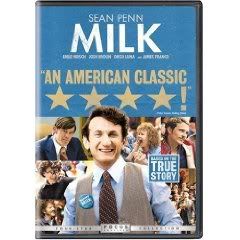
At this point, I think it's safe to say that we can all depend on Sean Penn. What an amazingly versatile actor, gifted with the ability to transform himself into virtually anyone from virtually any background. Even the God-awful 2006 remake of "All the King's Men" was made better by his portrayal of Willie Stark. He shines once again in Gus Van Sant's "Milk," a film that chronicles the final years of Harvey Milk, who became the first openly gay man to be elected into public office in California. Before his assassination in 1978, he managed to become a member of the San Francisco Board of Supervisors and was the driving force behind a number of demonstrations that challenged many anti-gay initiatives. His story could not be more perfectly timed; I live in California, where, in the last election, a proposition to ban same-sex marriage (Prop 8) was put on the ballot. I'm sorry to say that it passed (although, as of the date of this writing, the ruling is being challenged in California's Supreme Court). But social and political commentaries aren't the sum of the film's parts. "Milk" is a rich, enlightening character study, probing deeply into the minds of very different people. This brings me back to Sean Penn, who certainly had his work cut out for him as the title character. As an activist, Milk was such a unique personality--outrageous, bold, and even a bit theatrical, yet refreshingly earnest and straightforward at the same time. His beginnings, on the other hand, were much more conservative, and he kept it that way throughout most of his adult life. The story proper begins in 1970 on the eve of his fortieth birthday, at which point he's an insurance statistician in New York City. On the steps of a deserted subway station, he meets Scott Smith (James Franco). The two quickly become lovers, move to San Francisco, and open a camera shop in the Castro district. And yet, something is missing for Milk. "I'm forty years old," he observes, "and I haven't done a thing I'm proud of." Tired of guarding his sexuality and sick of the way law enforcement has been handling hate crimes, he soon establishes himself as a community activist, advocating equality for all. It isn't long before his political ambitions grow, and by 1975, he was ready to cut his hair, abstain from marijuana, and seriously pursue a position in city government. Three all-consuming, unsuccessful campaigns drive a wedge between Milk and Smith; by the time Milk is finally elected as a representative for the San Francisco Board of Supervisors in 1977, their relationship cools to a mere friendship. At this point, Milk has recruited Cleve Jones (Emile Hirsch), a young activist, and Anne Kronenberg (Alison Pill), a lesbian campaign manager. They do whatever they can to rally supporters, especially now that Milk is trying to pass a city ordinance that would protect people--many of them teachers--from being fired because of their sexual orientation. He faces an uphill battle with the Christian Right, specifically Senator John Briggs (Denis O'Hare) and singer/former orange juice spokeswoman Anita Bryant (seen only in actual archival news footage). He faces a battle of a different kind with Dan White (Josh Brolin), a Board Supervisor Milk suspects of being a closeted homosexual, despite his staunch anti-gay stance. Indeed, there's something both odd and desperate about White's behavior towards Milk, inviting him to his son's christening, showing up at Milk's birthday party drunk and shouting that he's got issues too. As White grows more and more resentful of Milk and his inner circle of political allies--specifically Mayor George Moscone (Victor Garbor)--we see less of a political figure and more of a man on the brink of emotional collapse. There's a fascinating association between the film's political message and Van Sant's cinematic creativity. A few select moments are true narrative masterstrokes, and they each involve quiet yet profound reflections in shiny objects. One of the earliest takes place early in Milk's political career, at which point gays in San Francisco were issued whistles; when Milk arrives at the crime scene of a murdered young man, his conversation with a police officer is shown entirely as a reflection off of a blood stained whistle. Another moment takes place much later on in White's living room, after Milk had established himself as a prominent politician. White's television set displays Milk in the middle of a news interview; we see White's reflection in the bottom left corner of the screen, and while we don't know what he's thinking, we do know that he's interested in what Milk is saying. One of the most striking subplots involves Milk and his new lover, Jack Lira (Diego Luna), who quickly proves that he's ill-equipped to handle Milk's rising political clout. He's painfully insecure, and it only gets worse as Milk's schedule goes from heavy to full. Lira clings to Milk like a frightened animal, which is understandable but also pathetic. The real sorrow comes from the fact that Milk was too busy fighting a good fight to take any notice. What if he didn't have anything to fight against? What if there was no discrimination? "Milk" will no doubt inspire many people, but it's also likely to infuriate many others. If you're like me, then you might feel a little bit of both. Why are we still at a point where equality has to be fought for? Are we not in the twenty-first century? Shouldn't we have gotten over this issue a long time ago? It's sad to leave a movie theater and realize that not much has changed in thirty years.
Caveman

Everyone has a favorite "stinker" in their home video collection, and this is mine. My girlfriend thinks I'm nuts. My friends cringe and turn the other way whenever I mention it. And my family offers me "special medication" if I try and get them to watch it...again.
But what can I say; I love this film. It's banality, shallowness, and out-and-out unscientific approach to modern man's changes and discoveries throughout the eons is just hilarious to watch. It's a ridiculous film, and so should be watched with that in mind. Why?
The story is about Atouk played by former Beatle master Ringo Starr, who is kicked out of his caveman tribe by the muscular and massive chief Tonda (probably lineman John Matuszak's only role on film, I'd guess) because he's in love with the chief's woman, Lana (a VERY busty Barbara Bach).
Once out on his own, Atouk begins to make new friends. They include Lar (Dennis Quaid), Tala (Shelley Long), Gog (Jack Gilford), Ta (Cork Hubbert), and a gazillion others. Among this rag-tag grouping comes the ability to stand up straight, how to cook a dinosaur egg, how to kill a rather large dragonfly by using someone's face (my favorite part in the film...but I felt bad for Dennis Quaid), the discovery of fire, music, drugs, homosexuality, and weapons, and just about a million years of evolution and discovery all wrapped up in one short, foolish film.
So call me a moron. Go ahead, it's okay. But this film is a great no-brainer, laugh-a-minute flick.
National Treasure 2 - Book of Secrets
Disney and Jerry Bruckheimer have dived yet again into their secret book to pull out a map that leads to treasures of vast fortune. No, not a legendary city of gold, but the riches that come from storming the box office. National Treasure: Book of Secrets is everything a big budget adventure sequel should be. A bigger story and better action help make Book of Secrets a surprising end of the year crowd pleaser.
Setting out to clear his ancestor's name, Ben Gates is back in treasure-hunting action to unequivocally prove that his family had nothing to do with the assassination of Abraham Lincoln. With his usual cohorts Riley, Abigail and his father, Patrick Gates, the trio must race against the clock to stop a new enemy, Mitch Wilkinson, from uncovering an ancient treasure before they can, or forever risk the Gates name being associated with the death of one of America's greatest presidents.

A hit for Nicholas Cage has been long overdue. Spanning nearly two full years making dud after dud, Cage is back and in good form, even if a sequel to the massively successful National Treasure was a safe no-brainer. Book of Secrets is just as outlandishly fun as its predecessor, one-upping the original by having the principle characters break into Buckingham Palace and even kidnap the President of the United States!
Kudos have to be handed over to screenwriters Cormac and Marianne Wibberley for crafting such a big adventure, yet staying true to the themes that director John Turtletaub and company established with the first National Treasure. Even though their new adventure takes the entourage of talented character actor's across the globe, Book of Secrets manages to keep this treasure hunt a uniquely American tale. Just wait until you see where our government hid one of the most famed and sought after treasures of all time!
Upping the production value from the last film, Book of Secrets is crammed packed with puzzles, car chases and exciting action sequences to help keep the film filled with riveting adventure from opening to closing frame. John Turtletaub has again done a great job of keeping the manic pace of the film frantic and fun, even if there are a few solitary moments when the picture starts to feel the weight of its lengthy running time.
While the returning cast again does a stellar job continuing their characters, newcomers to the series Ed Harris and Hellen Mirren are welcomed additions to the story. While Harris is perfectly suited for the role, his character, Mitch Wilkinson, seems to be the only weak link to the story. Wilkinson seems like a very torn individual. One minute the dastardly villain is opening fire on our heroes, vowing to end their lives to get at the treasure, and the next he is helping them!
Luckily the picture's best moments don't hinge on confrontations between Cage and Harris. The real fun of National Treasure has always been watching as the characters solve some of history's most challenging puzzles. Book of Secrets is assuredly no different, keeping audiences on their toes and tantalizing them with conspiracy theories that will likely continue the franchise forward.
Between massive Pirate's plunder and uncovering buried National Treasure, 2007 aims to be a financially lucrative year for Disney's live action department. With surprises at every turn, Book of Secrets has established National Treasure as a viable and fun adventure franchise, making the film a must see holiday blockbuster that the whole family can enjoy.
Dexter

Season 1 and 2 were 24 of the very best hours on television ever, no doubt about that.
But the third season is different. The story in itself is clever, well done and actually everything you could ask for after the mindblowing revelations in season 1, and the chilling struggle between Dexter & Doakes in season 2.
But then there is the pacing: whereas the first 2 seasons gained momentum throughout the first two, maybe three episodes and then kicked it up a notch by burying the viewer in an avalanche of great acting, suspense and brutal horror, season 3 doesn't really start until episode 5 or so. Read: most of ep 1-5 drag without anything stunning happening.
On the other hand, the 3 final episodes are crammed full of action and lightspeed storytelling. The season's two plot strands exist side by side and don't really connect until the very end, which makes for an awkward
story-telling.
The end itself feels rushed and strangely anemic, the tie-up feels a bit forced a doesn't deliver the satisfaction of the previous season finals.
It's great to see Dexter acting out of character, but certain moments conjure up scenarios usually to be found in daytime soap operas. The seasons comes across a bit too cheesy at times (in my opinion).
Also, the season suffered from a lack of David Zayas and could have used some more James Remar, but that's just me.
Still, Dexter is an outstanding drama series:
Michael C. Hall's acting is flawless, and guest star Jimmi Smits is perfect as the emotional, short-tempered counterpart to deadhearted, calculating Dexter.
Good season, yes ... but season 1 & 2 were absolutely brilliant, so ... 3 is somewhat of a letdown (but still a great show)
I hope for a better 4th season .
Last Chance Harvey

That was once an observation about my preferences in movies, that I enjoyed stories that seemed like they might happen to you, could happen, and were just about nothing really. And after spending the afternoon in Camarillo, CA in an art theater of very senior citizens in audience I think many felt it might happen too, because they gave a nice small gentle applause.
Even with their canes, assistants and wheelchair gear (noted to me by my companion holding up my poorly performing leg so I could hobble in) we were an older crew.
What was the movie? Hum. The story of a man, a jazz piano commercial jingle writer, coping with a pressure sounding job nightmare in a digitizing universe, going to London to see his daughter be married. His name is Harvey Shine, that is interesting because of course he is just Dustin Hoffman reprising himself as a romantic duffer, struggling with the job, with the marriage of a daughter he's lost to a divorce long ago, as she folded into her mother's remarriage. He's put up at a hotel, away from the entire family, apart, odd wheel. It carries so well those outsider feelings of this man, that has a daughter who doesn't seem to know him too well, that he later will say in a conversation in the film she always seemed a bit embarrassed by him, as he notes he had a child within something that never was quite right. Never right. It took a toll, one he obviously regrets,it hurts, but he knows another price had to be paid by his child who has almost become another man's child. Hard, impossible to verbalize. We miss in life on many things. In a series of hits and misses he then at this same time runs into Emma Thompson, oops Kate Walker I think, working for the airline, struggling with her own anxieties about her own scene of awkwardly attempting meeting someone, with nervous apprehension-anxieties over this. And as it seems to happen sometimes, he rebuffs her (ironically on his plane flight he was rebuffed by a passenger not interested in his chat) turns from her and some airline survey, only later to find himself after a horrible day running back into her at the airport as he fails to get the plane and get out of there to an essential work meeting. And finding a rapport then, a shift in the mind and heart, I think he can see her now. See her. After he's lost enough to understand when he is found. Or has found. Seeing.
It reminded me somehow of years ago when I was in my early twenties.Just a vague familiarity. A Cuban man drove me from the airport to a hotel down close to the Modern. A nice cabbie that talked and calmed a very fear-filled kid trying to figure out her life. Just a kind man. That's all. I was very nervous, unsure where I was, he was a great help, and I must have just told him I was afraid of not having too much money so I couldn't afford to pay more than thirty dollars. I was afraid of being overcharged. I know he didn't do that, my funds were so limited. I told him that. And I tipped him. I think he helped me get a room at a place I could afford. There is a point. A few days later I ran into him at Central Park at a festival. He and I just happily chatted like friends as he played some gaming thing on a day I needed to feel safer. It's a small world but this movie reminds me of how sometimes life hugs you in a very small corner. It allows you to listen to the tune played on the jazz piano. It gives you the blessing of a nice glass of rose.( I cannot figure out the accent on that e) And someone might actually wait for you to finish your class, as this new acquaintance does for Kate, or even walks with you all night or takes the risk to follow where someone leads.Or takes a hand or asks a favor.
Actually I've read the plot summarized here and at on-line movie sites ten times or more, when debating whether or not to risk my going out walking with such serious problems going on underfoot, so it isn't what I'd want to say-another synopsis. It wouldn't get it anyway. He goes to the wedding, is hurt by being replaced by the step dad told by the daughter in walking her down the aisle, meets this interesting, wary and lovely woman, loses his job, takes a risk, suffers a arrhythmia, almost misses a chance that he needs, she needs. And then there is her mom, calmly wondering if the neighbor is smoking bodies in the shed.
It's a little cozy movie about the lovely warmth of holding a hand and strolling into the life of another, because it's just righter than retreat.
I loved the littlest things. That there is some very old man in her writing class reading his sexual passages, that Harvey collapses when made to walk the kazillion flights of stairs at his hotel in London, both elevators off, that Emma Thompson wears this lovely silk lined raincoat so beautifully, that he goes to the pre wedding dinner with a white linen suit, crumpled with the tag not removed by the store, you know those inky ones, that they allow us to feel all the awkward staring discomfort, that Kate rolls up a little jacket or sweater to put under a child's head when they are belatedly seated at a child's table after the wedding at the reception. That he plays her a tune on the piano and asks her to stay, calming her discomfort knowing his own. That he gives her, and she him, the benefit of the doubt. That Kate goes to the rail with such anxiety when he tells her he's there, going to be there, why he missed her, and she sits and looks and admits to all the real fear of being hurt.
And he just absorbs that, and says he won't let her down.
Fireproof

Kirk Cameron totally stood me up. "Come to a screening of my new movie," he says. "I'll be there and it would be fun to meet up." So off I went yesterday, along with Aileen and our friends Julian and Stacey (yes, I think all of my friends have their own blogs), to attend a pre-screening of Fireproof in Buffalo, New York. But conspicuously absent was Kirk. He was a no-show. It hurt. (Though shortly after the movie ended, while I was drowning my sorrows in Dairy Queen, he called to apologize and say that his flight from L.A. had arrived late. I guess that's a pretty good excuse.)
On to the film.
Fireproof is a product of the team who brought us Facing the Giants, a film produced with a budget of merely $100,000 that went on to gross $15,000,000. In this new film Kirk Cameron plays Caleb Holt, a fire chief in Albany, Georgia. While he is loved by the men who work for him and regarded as a hero in his town, Caleb struggles in his relationship with his wife, Catherine. After seven years of marriage it seems that the relationship is growing cold. Caleb finds solace in looking at pornography on the Internet while Catherine finds herself in a growing relationship with a colleague. As the couple begins to steel themselves for a divorce, and as they begin the process of ending their marriage, Caleb's father presents him with a book and challenges him to begin a 40-day experiment he calls "The Love Dare." Caleb decides to give it a shot, though he does so more to respect his father than to salvage his failing marriage. Struggling to show love for his wife even as she continually rejects him, Caleb calls his father and asks, "How am I supposed to show love to someone who constantly rejects me?" This gives his father an opportunity to share the gospel with him and, armed with the reality of a new love, Caleb sets out to win back his wife's heart.
I can be excused, I think, for entering the theater somewhat apprehensively. After all, Christians do not have the greatest track record when it comes to combining great spiritual truths with sound art. But in the case of Fireproof I was pleasantly surprised. The film, though produced with a limited budget compared to most of what we see on the big screen, is very well put together. There are really no occasions where I feel a bigger budget might have improved the film, and this despite a couple of extended action sequences where I would almost expect to see quality compromised by budget restrictions. This is clearly not the case.
This is not to say the movie is without blemish. There are a few occasions when the dialog becomes just a bit stiff or stilted and this is especially true in the film's opening moments. There are a couple of times when I feel that portions of the script could have done with just a little bit more tweaking or when a scene could have benefited from just one more take. Also, I feel that a handful of the minor characters are too weak, either through lack of development or through sub-par acting. But these are really the only downsides worth mentioning. (Is it worth mentioning that everyone in the town has a good Georgia accent except for Caleb? How is it that his father and mother both have that southern drawl and he doesn't?)
Kirk Cameron is very solid in the lead role and was a great choice for it. He is strong throughout and at key moments, when given the chance to shine, is outstanding. Erin Bethea, who plays opposite Cameron as Catherine Holt is also very good, and this despite Fireproof being her first major movie role (and only her second role overall). Caleb's father is excellent as a wise, loving, pastoral father. The prominent characters develop well and I found myself genuinely drawn into the story. While the movie deals with difficult and serious themes, it does not take itself so seriously that it cannot pause for a few laughs now and again.
One thing I like to evaluate in Christian movies is whether the film inserts faith themes subtly or blatantly. In the case of Fireproof the person who watches this film will walk away with absolutely no doubt that it is a Christian movie. Faith figures prominently and the gospel is clearly presented. Sinful actions and decisions are shown to have negative consequences and are eventually rebuked. While "The Love Dare" is used to draw Caleb back to his wife, it is clear that this is merely an instrument used by God to do His work. This movie is Christian by any measure. It sweeps to an ending that is powerful and emotional, stirring to tears at least several of the people in the theater with us.
I enjoyed Fireproof and am excited to know that, come September 26, a film with such a good message will be debuting on hundreds or thousands of screens across America. It is a refreshing film with a refreshing message that speaks boldly to a culture infatuated with immorality and convinced that divorce is freedom. I am grateful for this film and pray for its success.
Taken

Who would have ever thought that Hollywood would attempt to include an important topic to serve as the basis for one of its typically generic, yet entertaining action films? Generally these films are created to provide mindless escapism along with a hefty dose of guns and fist-fights, or just to be another brainless vehicle showcasing the action star of the moment. In the case of "Taken", a much more serious topic, the trafficking of women, serves as the catalyst for all the mayhem that ensues over the course of the film.
"Taken" is the story of a young girl named Kim (Maggie Grace), who takes a trip to France with a friend for the summer; however, what should have been a trip filled with good times and fond memories, turns horribly wrong when they are kidnapped for the sole purpose of being sold into a dark underworld of sex and drugs. What the kidnappers didn't count on was that Kim's father, Bryan (Liam Neeson), is a man of rather "special" talents that he learned during his time spent working as a spy for the United States government. With his daughter's life in jeopardy, Bryan must call upon every deadly skill he's ever learned to track down those responsible and save his daughter before it's too late.
Filmmaker and writer Luc Besson ("Transporter" series) has made a career out of delivering to audiences bone crushing, overly stylized and over-the-top action movies that entertain us, but don't really give us anything new in terms of story or emotional range. With "Taken" Luc Besson, along with co-writer Robert Mark Kamen ("Transporter 2"), imbues the story with a much more serious, emotionally charged backbone. The seedy underworld of kidnapping and trafficking women for sex is one that exists without a whole lot of attention being called to it, thus making this film's message all the more important. The story is wisely written in such a way that it gives us just enough of a glimpse into this world that we become more enlightened as too some of the new threats out there, but not so graphic that the film is too shocking for most people to see. By handling the subject matter in this somewhat delicate manner, some would say it just glossed over the evil done in this so-called "business", but the message is able to reach a much broader spectrum of people than a harder edged movie would have been able to. For those feeling that the film didn't do enough to expose the despicable nature of this world, I do agree, but I understand why it was a better decision not to go too far with it. Because to go too hard and gritty with this movie by being too explicit, you run the risk of limiting and/or alienating your audience, which is not something you want when dealing with such a serious topic.
Even with the much heftier subject matter, "Taken" still could have run the risk of being just a slightly above average action movie if not for the considerable talents of star Liam Neeson. Liam brings to the character of Bryan a gentleness and an obvious love for his daughter in the early portion of the movie, so that when the rubber really hits the road, the actions he takes to find her, and the ferocity in which he acts is completely believable. Regardless of how brutal Bryan may act towards these undeniably deserving adversaries, he never becomes inaccessible to the audience. This is because Liam's gravitas and at times emotional performance keeps the audience invested in his character and his mission. Sometimes in an action movie, the action can become too front and center that the how's and why's of the story (no matter how important and central they may be to the action) get forgotten about until the very end when they are conveniently re-introduced to the audience as a reminder. For "Taken" this is not the case, as Bryan's love for his daughter and unwillingness to give up on finding her always remains front and center, even during the action sequences.
Other members of the cast included Famke Janssen ("X-Men" trilogy), Maggie Grace ("The Fog"), and Leland Orser ("The Bone Collector"). Each of these supporting actors and actresses do a good job with the little time they do receive onscreen. Primarily this movie belongs solely to Liam Neeson, while the supporting roles are nothing more than glorified cameos, which suits this type of film perfectly. Out of the supporting cast, Maggie Grace probably gives the best performance, because had it not been for her emotional connection with Liam in the film's early scenes, the audience wouldn't have been able to connect with him as much later on. Sure, the story would have still impacted us in some way, but by having their relationship feel so realistic, it made our connection to him throughout the remainder of the film all the more palpable.
Lastly, first time director Pierre Morel brings his keen eye for action to the proceedings with great effectiveness. Pierre's work as Director of Cinematography on the action film "War", starring Jet Li and Jason Statham, clearly served as great preparation for his work on this film. While I didn't enjoy the aforementioned film all that much, the action scenes were handled very well, much the same way as they are here. Unlike many of writer Luc Besson's action films, "Taken" contains none of his trademark over-the-top, overblown action sequences that while incredibly fun to watch, are completely unbelievable. Instead, Pierre opts to keep the action realistic and up-close and personal, while still providing plenty of hard-hitting, fast-paced (somewhat stylized) fight sequences, that don't really feel all that unbelievable or obviously choreographed.
"Taken" is a great action film that offers plenty of violence for the action junkies, while at the same time providing some solid acting, and a story that shines a light on a dark world that needs to be exposed and put to an end.
True Blood

I was determined to resist HBO's True Blood, a Southern Gothicky romp through Bon Temps, Louisiana, where, thanks to the invention of synthetic blood, vampires have "come out of the coffin" to mainstream with humans. One such creature of the night is Bill Compton (Stephen Moyer), a 173 year-old reluctant vampire who has all the candor of a good heart but the physical attributes of the netherworld. Bill is enchanted by Sookie Stackhouse (Anna Pacquin), a waitress at Merlotte's, the town watering hole. Tormented all her life by the ability to read other people's thoughts, Sookie and Bill stare at one another across the crowded bar like Maria and Tony in their memorable scene from West Side Story, the world falling away before the two of them. Hopelessly attracted, yet fearful of Bill's bad boy side (after all, he is a blood-slurping vampire), Sookie vacillates, her heart telling her this is the one, her mind screaming, "Are you crazy? He's dead!" But- unexpected joy- she can't read his thoughts! Certainly, these two will never be able to gaze lovingly at one another across the breakfast table.
As the opening credits suggest in Alan Ball's clever and ambitious series, the south harbors the gamut of human- and inhuman- behavior, superstition, faith, love, hate, folksiness and generosity, charm and the KKK, all God's children frolicking in a world both dark and light. While vampires lurk in the night, seductive in their dangerous otherness, humans range from good ol' boys to southern belles, a mélange of the dramatic and the demure, the cast a surprising mix of eccentric and fascinating personalities: Sookie's brother, Jason (Ryan Kwanten), a relentless sex addict who loves a mirror almost as much as the willing ladies her pursues; the foul-mouthed, yet endlessly appealing Tara (Rutina Wesltey), as unable to govern her emotions as she is to cast out the "devil" who inhabits her soul; and Lafayette (Nelsan Ellis), a real scene-stealer, gay short-order-cum-"V"-dealer (the potent and coveted vampire blood) who owns his scenes, his talented barely contained by the small screen.
Unfortunately for the incipient romance between virgin and vampire, a series of recent murders has focused the town on the vampires' tendency toward blood lust, although, as Bill informs local law enforcement, "Surely a vampire would have drained a body of every ounce of her blood." Still, the residents of Bon Temps are reluctant to cast suspicion on one of their own. Bill's seduction of Sookie drives the series, but the town is filled with such a delightful mix of characters that, like "V", there is never enough. Highly addictive, like the one-step-behind law enforcement team who bicker from crime scene to crime scene, there is always another volatile contretemps to charm, amuse and shock the willing viewer. Pacquin is stellar in her portrayal of Sookie, Moyer barely one beat behind her performance and closing (fangs extended). I have been bitten. I willingly drank the vampire's patented Tru-Blood and freely admit: one taste of "V' isn't enough.
"Must see" TV for me is defined as watching every episode of "True Blood" on Sunday night as originally aired then rewatching and savoring each episode as recorded on demand. We watched the first season of "True Blood" over and over again yet highly anticipate the preordered DVD just so we can view each episode with director and cast member commentary. For instance, at the 42 minute mark in the final episode of the season, Ryan Kwantin who plays Sookie's brother Jason comforts his sister recovering from the brutal beating she suffered and as Jason turns to leave, trips over the coffee table and nearly falls on his face. I personally think that pratfall was an accident. I'm guessing creator Alan Ball decided to retain that scene because it worked so well and so naturally to define troubled yet likeable Jason's basic humanity. The commentary track normally included with most DVD packages should disclose if my suspicions are correct. It will be fun to find out either way.
Virtually every single cast member in this wickedly funny and at times shockingly graphic series is so believable and so downright likeable that the basic story line of vampires coming out of the closet in Louisiana to openly walk among us while demanding equal rights has an uncommon way of encouraging the casual viewer to examine his or her own personal prejudices in off beat, highly entertaining and altogether unexpected ways.
Of course there will always be those who grouse that the storyline does not strictly follow the series of books by Charlaine Harris. Series creator Alan Ball argues there is a very good reason for that. The fact is Anna Paquin, recent Golden Globe winner for her turn as Sookie Stackhouse would be the most overworked actress on the planet if the storyline was strictly adhered to because as the books are written she would dominate virtually every single scene. Whew! Not only that, we would not have become so familiar with several of the wonderful characters we have been introduced to, specifically Tara, Jason and Lafayette as played by Rutina Wesley, Ryan Kwanten, and Nelsan Ellis respectively. These and many, many other gifted actors contribute mightily to making "True Blood" the runaway hit it has become. As any ardent fan of the book series knows, Season One barely scratched the surface and plenty of rich material has yet to be mined. If the series continues to be skillfully written, "True Blood" can easily air for 3, 4, even 5 or more seasons
Subscribe to:
Posts (Atom)